The playdate goes well. Your child is thrilled, already planning the next one before the other kid has even left. And then the invitation never comes back around. Or it does, once, and then quietly stops. You watch this pattern repeat, sometimes for years, and it's often harder to sit with than almost any academic struggle, because friendship feels like it should just happen naturally, and for your child, it often doesn't.
If this is familiar, it helps to know two things at once: this is one of the most consistently documented challenges for children with ADHD, and it's genuinely something that responds to the right kind of support, not something to simply wait out.
What the Research Actually Shows
Multiple long-term studies have found that children with ADHD experience meaningfully higher rates of peer rejection and lower-quality friendships than their peers, patterns that tend to persist into adolescence rather than resolving on their own. This isn't a minor social footnote. Research following children with ADHD over years has linked ongoing peer rejection to a real, measurable increase in later difficulties, including anxiety and broader social impairment, separate from ADHD symptoms themselves.
The reasons behind this are more specific than "kids can tell something is different." Core traits associated with ADHD, difficulty with turn-taking, interrupting mid-conversation, missing subtle social cues, and stronger emotional reactions in the moment, directly affect the exact behaviors peers use, often without realizing it, to decide who they want to keep playing with. None of this reflects a lack of caring. A child with ADHD often wants connection just as much as any other child, and frequently more visibly so, which can make repeated rejection especially painful to witness as a parent.
It's also worth knowing that this pattern isn't unique to boys. Research specifically looking at girls with ADHD has found similarly high rates of peer difficulty and social exclusion, often less visible to adults because it shows up as quiet withdrawal rather than the more noticeable conflict sometimes seen in boys, a distinction we'll explore further in a future article on how ADHD often looks different in girls
How This Actually Shows Up Day to Day
On the playground, it can look like a child who genuinely wants to join a game, jumps in without waiting for an opening, and inadvertently disrupts something the other kids had already built momentum around, leaving the group frustrated in a way your child often doesn't fully register in the moment.
In conversation, it can look like a child who interrupts constantly, not out of rudeness, but because holding a thought while waiting for a natural pause is a genuinely harder executive function task for a child with ADHD than it is for many of their peers. Over time, other kids can start to read this as not listening, even when the opposite is often true, your child is usually listening intently, just struggling to hold the response until the right moment.
During group activities, it can look like a child who reacts to a small setback, losing a turn, a rule going against them, with a burst of frustration that seems outsized to peers who don't understand what's happening underneath it. A single strong reaction, repeated across enough interactions, can start to shape a reputation well before anyone has had a chance to see the fuller picture of who your child actually is.
And often, it looks like something quieter and harder to spot at all: a child who stops asking for playdates, who says they don't really like recess, who seems to have simply adjusted their expectations downward rather than continuing to push for connection that hasn't been coming easily. This version is easy to miss precisely because it doesn't look like a crisis. It just looks like a kid who's stopped trying, which is its own kind of warning sign worth taking seriously.
Why "Just Be Nice to People" Doesn't Fix This
Generic social advice tends to assume a child already has the underlying skills and simply needs motivation to use them. For a lot of children with ADHD, the gap isn't motivation. It's the specific, moment-to-moment social skills that most children absorb somewhat automatically, reading when a conversation has shifted, noticing a friend's expression change, waiting the right amount of time before speaking again.
This connects closely to what we've explored in how to handle ADHD meltdowns: a child who becomes emotionally flooded quickly in a one-on-one setting is also more likely to react strongly to small social frustrations, a lost game, a perceived slight, in ways that can feel disproportionate to the peer involved, even when the underlying feeling is completely genuine.
Quality Over Quantity, With an Honest Caveat
It's tempting to assume that having even one solid friendship automatically protects a child from the effects of broader peer rejection. Some research supports this. Other long-term studies, however, have found that having a mutual friend didn't meaningfully reduce the negative outcomes associated with peer rejection at school overall. The honest, current picture is more nuanced than a single reassuring rule: friendship quality and the broader social environment both seem to matter, and neither one alone appears to fully offset the other.
What this means practically is that supporting a single friendship is valuable and worth real effort, but it isn't a complete substitute for also paying attention to how your child is doing in the wider peer group, at school and beyond.
What Actually Seems to Help
Keep Early Playdates Short, Structured, and One-on-One
Research and clinical experience both point in the same direction here: shorter, structured playdates with a single peer tend to go better than longer, unstructured time with a group. A defined activity with clear rules gives a child with ADHD less open-ended social space to misstep in, and a natural, built-in end point before things have a chance to unravel.
Coach Before, Debrief After, Without Shame
A short conversation before a playdate, naming one or two specific things to remember, taking turns, checking in if a friend seems upset, gives a child something concrete to focus on rather than relying on social instinct alone. Afterward, a brief, curious debrief, what went well, what felt hard, works far better than a critique, and it avoids reinforcing the kind of harsh self-talk we explored in the voice a child uses with themselves, which peer struggles can make considerably worse if a child starts to internalize rejection as a verdict on their character.
Teach Repair as Its Own Specific Skill
Conflict itself isn't usually what ends a friendship. How it's handled afterward often is. Directly teaching a child what a genuine apology and repair actually look like, specific words, not just "say sorry", gives them a tool that matters enormously here, since research has noted that children with ADHD often struggle specifically with resolving conflict within existing friendships, not just avoiding conflict altogether.
This is worth practicing outside the heat of the moment, not just after a real conflict has already happened. A simple role-play at home, using a made-up scenario rather than a real recent fight, gives a child room to try the words out without the added pressure of an actual friendship on the line. Over time, having a small, practiced script, "I got frustrated and I shouldn't have said that, can we try again", makes the real version far more accessible in a moment when emotions are already running high and finding the right words from scratch would be much harder.
It also helps to normalize that most friendships, for every child, involve some degree of conflict and repair along the way. A child who believes a good friendship should never involve any friction at all may experience an ordinary disagreement as evidence the friendship is already over, rather than as a normal part of it that simply needs to be worked through.

Build Around Shared Interest, Not Just Shared Age
Structured activities built around a genuine interest, a sport, an art class, a specific club, tend to create more natural, resilient friendships than proximity alone, since the shared activity gives children something concrete to bond over and fall back on when conversation alone feels harder to sustain.
Loop In Teachers as Real Partners
Some research has found that the quality of a child's relationship with their teacher plays an unusually strong protective role against peer rejection for children with ADHD specifically, more so than for their neurotypical classmates. A teacher who understands your child's specific social strengths, and who models warmth toward them in front of the class, can meaningfully shift how peers perceive them over time.

The Line Between Supporting and Taking Over
It's worth naming a real risk directly: it's possible to support a child's friendships so closely that they never get the chance to practice navigating small social missteps on their own. Hovering during playdates, jumping in at the first sign of friction, or debriefing every single interaction can unintentionally signal that you don't trust them to handle it, which can undercut confidence more than the original social struggle would have.
The goal isn't to engineer every interaction. It's to build the underlying skills, then step back enough to let your child actually use them, missteps included, since some of that practice is exactly how the skill becomes real.
A Longer View
Friendship difficulties in childhood don't have to be a fixed forecast for adolescence or adulthood. The research is clear that this is a genuine area of struggle, and equally clear that specific, structured support meaningfully changes the trajectory. This is less about finding one dramatic fix and more about steadily building a small set of real skills, turn-taking, reading a shifting mood, repairing a conflict, the same patient, structural approach that tends to work across nearly every ADHD-related challenge, rather than waiting for social ease to simply arrive on its own.
Before the Friendship Skills, There's the Relationship With Self
Every strategy in this article, coaching before a playdate, repairing after conflict, reading a shifting mood, asks a child to draw on something underneath all of it: a basic sense of their own worth, steady enough to survive an awkward moment, a rejected invitation, or a friendship that didn't work out. A child who is already quietly convinced that they're "too much" or "bad at this" brings that belief into every social interaction before they ever say a word, and it shapes how they read a peer's reaction, how quickly they give up trying, and how harshly they judge their own mistakes afterward.
This is part of why the inner relationship tends to come first, practically as well as emotionally. Growing With Max was built around exactly this groundwork, a gentle, 15-day morning and bedtime routine that helps a child build a steadier, kinder inner voice, through short stories, honest affirmations, and small daily practices, alongside a character who's still learning too. It isn't a social skills program, and it won't fix a specific friendship on its own. What it offers is the quieter foundation underneath the skills in this article, a child who believes she's worth trying again for, even after a friendship stumble, is simply better positioned to actually use every strategy above.
If you're looking for a small, steady place to start building that foundation before, or alongside, the social skills your child is working on, Growing With Max is worth exploring.
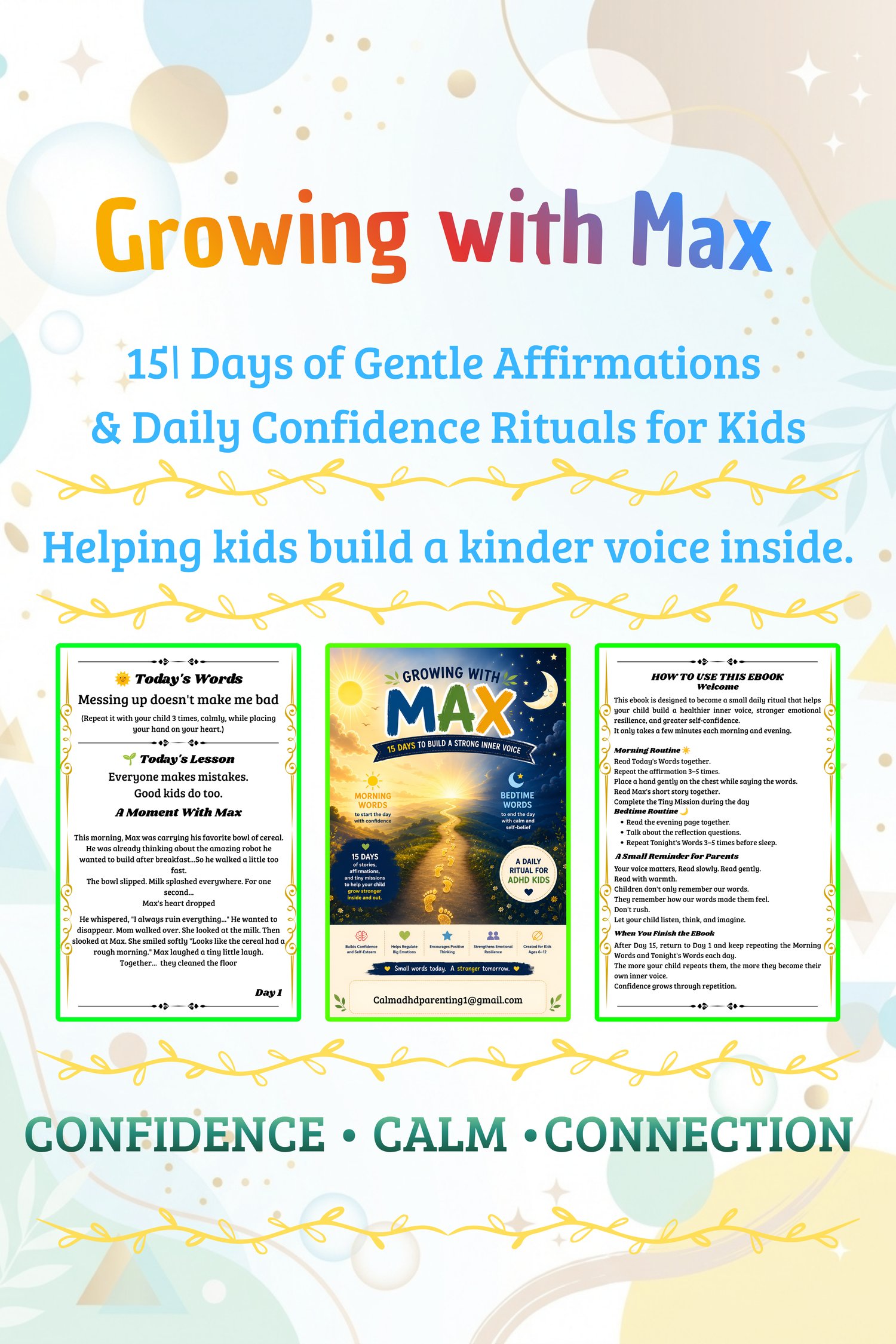
Growing With Max
15-Day ADHD Affirmations & Daily Confidence Ritual for Kids
A simple, gentle daily ritual to help children with ADHD build confidence and develop a kinder inner voice.
Go to product pageDigital workbook · Instant download ·
Comments
Post a Comment