
The teacher says he had a great day. No notes home, no behavior chart flagged, nothing unusual reported at pickup. And then, somewhere between the car door and the front hallway, something shifts, and by the time you're both inside, he's yelling about something small enough that it barely registers as a real trigger, or he's slammed his bedroom door and won't answer you at all.
If this exact pattern repeats itself most weekdays, you're not imagining a contradiction. There's a well-documented explanation for it, and understanding what's actually happening changes almost everything about how to respond in that first difficult hour.
What's Actually Happening: Restraint Collapse
The pattern has a name in child development literature: after-school restraint collapse, a term coined by psychotherapist Andrea Loewen Nair to describe what happens when a child has spent hours actively suppressing impulses, managing frustration, and holding together a level of composure that takes real, sustained effort, only to release all of it the moment they reach a place that feels safe enough to stop performing.
For a child with ADHD specifically, that effort is often considerably higher than it is for classmates. An entire school day can mean sitting still when their body is wired for movement, filtering out distracting noise, decoding social rules in real time, and following instructions delivered at a pace that doesn't naturally match how their brain processes information, all while trying to look and behave like everyone else around them. By the time the school day ends, the mental and emotional reserves needed to keep managing all of that have often been fully spent.
Home becomes the first place all day where the pressure to hold it together finally lifts, and for many children, that relief comes out as anger, tears, or a complete shutdown rather than calm relaxation, precisely because there was nowhere for the accumulated tension to go until now.
Why This Isn't Defiance, and Isn't About You
It's worth being direct about this, because it doesn't feel that way in the moment: a child unraveling the second they see you isn't a sign that something is wrong with your relationship, and it isn't evidence of bad parenting. If anything, it tends to reflect the opposite. Children generally only let their guard down this completely around the people they trust most to handle it, which means you being the target of this collapse is, in a strange way, a sign of how safe you actually are to them.
This is a genuinely different phenomenon from the kind of meltdown we've explored in how to handle ADHD meltdowns, which usually has an identifiable trigger in the moment itself. Restraint collapse often has no clear trigger at all, or a trigger so small it wouldn't normally register, because the real cause isn't the trigger, it's the entire day that preceded it.
Why "How Was School?" Often Backfires
Asking a depleted child to immediately recount and process their day is, for a lot of kids with ADHD, a genuinely demanding cognitive task in its own right, verbal processing and organizing a narrative both draw on exactly the mental resources that are already running on empty at this exact moment. A question asked with warm intentions can land as one more demand on a system that has nothing left to give, which is often why it triggers irritability rather than conversation.

What Actually Helps: A Decompression Period First
The most consistently recommended response across clinical guidance is remarkably simple: build in a genuine decompression period immediately after school, before any questions, demands, or transitions, typically twenty to thirty minutes of low-pressure quiet, a snack, and space, before expecting engagement of any kind.
This isn't about ignoring your child or withholding connection. It's about recognizing that connection right now doesn't require conversation. A quiet presence nearby, without pressing for details or immediate compliance with the next task on the schedule, often does more to help a depleted child recover than any well-meaning question could in that first stretch of time.
Let the Body Release What the Day Built Up
Physical movement, running outside, jumping, anything that lets pent-up energy actually discharge, tends to help considerably more than sitting still with a screen, even though a screen often feels like the easier, quieter option in the moment. Some of the techniques we've covered in calming the ADHD brain without medication apply directly here, physical outlets aren't just for managing hyperactivity during the day, they're often exactly what's needed to help a nervous system come back down after holding tension in all day.
Avoid Discipline in the Middle of a Collapse
Punishing or lecturing a child in the middle of restraint collapse tends to backfire, since the part of the brain responsible for reasoning and self-control is precisely the part that's already run out of capacity. Whatever needs to be addressed about the behavior itself is almost always better handled later, once your child has genuinely recovered, rather than in the middle of the collapse itself.
Watch for Patterns Worth Investigating Further
Occasional restraint collapse is common enough in children with ADHD that it doesn't automatically signal a school problem. But a pattern that's intensifying, lasting far longer than usual, or including physical aggression toward people or property is worth paying closer attention to, and it's a genuinely useful thing to raise directly with your child's teacher. The kind of collaborative relationship we explored in building a real partnership with your child's teacher can help you figure out together whether something specific at school, a change in routine, a social difficulty, an increase in academic demands, is adding extra weight to what's already a demanding day.

Build the Same Decompression Time Into the Routine, Not Just the Bad Days
Treating this as an expected, built-in part of the after-school routine, rather than something you only respond to once things have already gone sideways, tends to shorten both the frequency and intensity of the collapse over time. A consistent, predictable decompression period signals to your child's nervous system that the demand has genuinely ended for the day, which for many kids is exactly the reassurance needed to let the tension go more easily each time.
A Different Way to See the 4pm Meltdown
An after-school collapse isn't a sign that your child had a bad day, and it isn't a reflection of anything going wrong at home. It's the visible cost of an entire day spent working harder than most people realize to hold everything together, released in the one place your child trusts enough to finally let it go. Responding with a quiet decompression period rather than immediate questions or consequences doesn't just make that first hour easier. Over time, it can genuinely shorten how long the collapse lasts at all.
Building the Steadiness Underneath the Collapse
Decompression time helps in the moment, but many parents find that what actually shifts the pattern over weeks and months is something happening earlier in the day, how a child talks to themselves about the effort they're putting in, and how much internal steadiness they're carrying into a demanding school day in the first place. A child who's already quietly telling themselves "I can never keep it together" tends to arrive home with less in reserve than one who's practiced, even briefly, believing they can handle a hard day and still be okay.
This is exactly the groundwork **Growing With Max** was built to support. Through a gentle 15-day morning and bedtime routine, short stories, honest affirmations, and small daily practices, children build a steadier relationship with themselves, one that many parents report shows up in real, visible ways: a calmer walk in the door, a shorter recovery time, a child who can name what they're feeling instead of only exploding it outward. It isn't a fix for restraint collapse on its own, and results vary from child to child, but for many families, a few consistent minutes each morning and night has meant afternoons that feel a little less like a daily storm to brace for.
If your afternoons have felt like this more often than not, Growing With Max may be worth exploring as part of what helps your child carry a little more steadiness home each day.
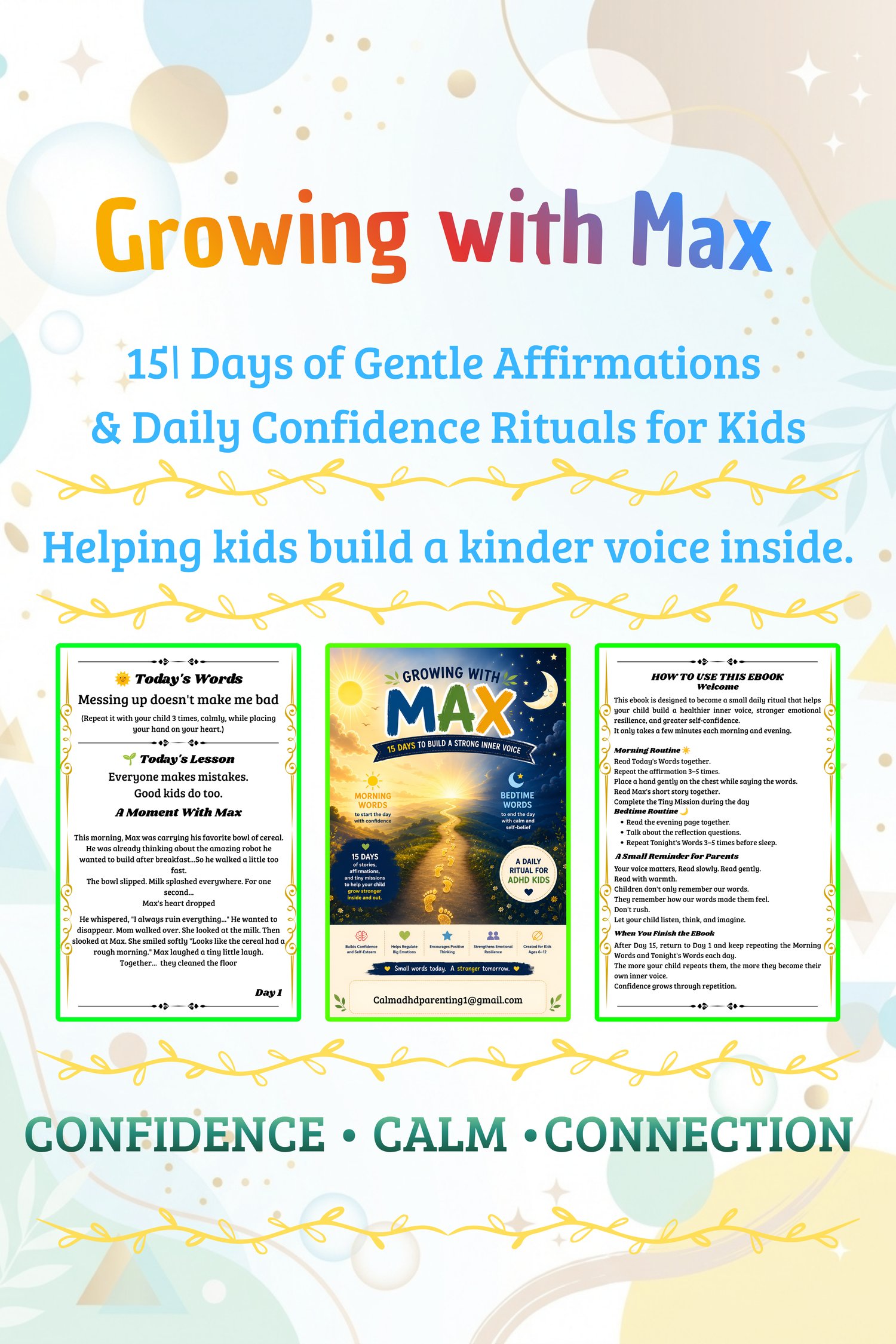
Growing With Max
15-Day ADHD Affirmations & Daily Confidence Ritual for Kids
A simple, gentle daily ritual to help children with ADHD build confidence and develop a kinder inner voice.
Go to product pageDigital workbook · Instant download
Comments
Post a Comment