How Your Child's Words Change Their ADHD Brain: A Science-Based Guide to Positive Self-Talk and Self-Love
How does positive self-talk change an ADHD child's brain? A science-based, practical guide for parents.
Introduction:
When Inner Words Become a Silent Enemy
Your child sits down to a simple homework assignment. They try once, get it wrong, try again, and then whisper to themselves, barely audible: "I'm so stupid, I'll never get this." They didn't say it to you. They said it to themselves, like a settled fact rather than a passing feeling.
This scene is familiar to many parents of children with Attention Deficit Hyperactivity Disorder (ADHD). But the question we rarely ask is this: what if the words a child says to themselves aren't just a reflection of how they feel, but an actual factor shaping how their brain works?
The relationship between positive self-talk in ADHD and brain activity isn't just motivational language. It's a subject of growing research in cognitive neuroscience. In this article, we'll walk through that relationship from a scientific angle, explain why children with ADHD in particular need to learn self-love and positive self-talk, and then offer practical strategies parents and educators can start using today.
The Brain and Words: The Neural Connection
Neuroplasticity: A Brain That Can Reshape Itself
One of the most important concepts every parent should understand is neuroplasticity, the brain's ability to reorganize itself and build new neural pathways in response to experience and repetition. The brain, especially a child's brain, isn't a fixed structure. It's a living system that keeps changing based on what a child experiences daily, including the words they repeat to themselves.
This means that repeated negative self-talk, phrases like "I'm a failure" or "I'll never succeed," doesn't stay a passing thought. With repetition, it can become a preferred neural pathway, one the brain defaults to automatically in difficult moments. The reverse is also true: repeating honest, realistic, positive self-talk can help build alternative pathways, ones that are more supportive and less harsh.
Words and Dopamine: The Reward and Motivation Network
Some research suggests that positive words may activate what's known as the brain's reward and motivation network, the network associated with pleasure, motivation, and learning, and believed to be connected to the release of dopamine, the neurotransmitter linked to feelings of accomplishment and satisfaction.
In other words, when a child tells themselves, "I tried, and I did what I could," that self-talk doesn't just comfort them emotionally. It may also help activate a neural circuit that makes them more likely to try again in the future, rather than withdrawing or giving up.
The Difference Between Positive and Negative Self-Talk
Some studies using functional MRI (fMRI) have found that positive and negative self-talk produce different patterns of brain activity, particularly in regions associated with attention regulation, alertness, and cognitive performance. This supports the idea that self-talk isn't just a "feeling," it appears to leave a measurable signature on how the brain functions.
Why Children With ADHD Especially Need Positive Self-Talk
Delayed Development of Inner Speech
Researcher Russell Barkley, one of the most prominent figures in ADHD research, developed an influential theory suggesting that children with ADHD often experience a delay in the transition from overt self-talk, speaking out loud, to covert, silent inner speech, the kind most neurotypical children gradually use to regulate their behavior and guide themselves without needing to speak aloud.
This delay isn't a matter of intelligence. It reflects a real difference in the maturation of executive function, which makes self-talk, whether spoken aloud or internal, a foundational regulatory tool for these children, not a habit that can simply be dropped.
The Sheer Volume of Daily Negative Messages
Some estimates suggest that a child with ADHD may receive an unusually high number of corrective and negative messages during their early years, "pay attention," "calm down," "why can't you sit still like everyone else." Even if the exact numbers aren't precisely verified, the underlying point is well supported: the daily repetition of correction, even when well-intentioned, leaves a cumulative mark on how a child comes to see themselves.
Amplified Self-Criticism
Because of their repeated experiences with frustration and comparison, children with ADHD tend to develop sharper self-criticism than their neurotypical peers. If left unaddressed, this inner critic can, over time, harden into a fixed thinking pattern that makes it harder for a child to accept mistakes or try again.
Positive Self-Talk as a Regulatory Tool, Not Just Encouragement
It's important for parents to understand that self-talk in a child with ADHD isn't a sign of disorder or an odd habit. It's a genuinely powerful regulatory tool, when used the right way.
Positive self-talk can help a child with:
- Emotional regulation — by naming a feeling instead of erupting into it.
- Problem-solving — by talking themselves through a complex task step by step, out loud.
- Task completion — by reminding themselves of the next step instead of losing focus.
- Working memory support — by quietly repeating instructions to themselves while carrying them out.
This perspective also connects closely with the principles of Cognitive Behavioral Therapy (CBT), which is built largely on the idea that how we talk to ourselves directly shapes our emotions and behavior, not only the reverse.
How to Teach a Child Self-Love and Positive Self-Talk: Practical Strategies
Strategy One: Model It — Talk Out Loud While You Work
Children often learn inner speech by hearing the adults around them do it first. Try narrating your own thinking out loud in front of your child while completing a task: "Okay, I got that step wrong. That's fine, let me try a different way." This gives your child a living example of balanced self-talk, neither perfectionist nor harsh.
Strategy Two: Specific, Targeted Praise
Instead of "good job," try being precise: "I noticed you finished that assignment even though it was hard. That took real persistence." Specific praise teaches a child exactly what they did to earn recognition, and it's more effective than general praise at building an accurate self-image.
Strategy Three: Turn "I Can't" Into "I'll Try"
When your child says "I can't," don't correct them with an unrealistic, perfect phrase like "of course you can." Instead, help them reframe it: "Maybe I can't do this yet, but I can try." This small shift keeps things honest while still leaving room to attempt it.
Strategy Four: Acknowledge Effort, Not Just Outcome
Focus on the process, not only the final result. Ask your child, "What part was hard, and how did you handle it?" instead of focusing only on the grade or the outcome. This teaches a child that their worth isn't measured by success alone, but by the act of trying itself.
Strategy Five: Simple Daily Affirmations
Choose short, honest phrases together that your child can repeat in difficult moments, such as, "My mistakes don't decide who I am," or "I can calm down and try again." These phrases need to be simple enough for a child to remember, and honest enough for them to actually believe.
Strategy Six: Quality Time to Build Secure Attachment
Spending even ten focused minutes a day with no correction, no instructions, just presence and attention, builds a sense of psychological safety that's essential groundwork for any work on positive self-talk. A child who feels safe with their parents is far more able to accept mistakes without experiencing them as a threat to their own worth.
What Does the Research Say?
Some studies have found that interventions based on positive self-talk, used proactively in the classroom, contributed to an increase in on-task behavior among children with attention difficulties. Other research has pointed to the effectiveness of Mindful Self-Compassion interventions in improving self-esteem among adolescents with ADHD, by teaching them to meet their own mistakes with kindness rather than the harsh self-criticism they're more prone to.
These findings, while still part of an active and evolving area of research, clearly support this article's central point: the way a child talks to themselves isn't a minor detail. It's a factor that genuinely influences both their performance and their psychological wellbeing.
Conclusion:A Journey That Begins With One Word
Teaching your child with ADHD to speak to themselves with kindness isn't a task completed in a single day. It's a habit built through repetition and patience, in exactly the same way the brain learns any other new skill. You don't need to be perfect on this journey as a parent. You need to be present and consistent, and to remind your child, and sometimes yourself, that a mistake isn't the end of the road.
If you're looking for a practical tool to help your child build self-confidence and learn positive self-talk in a way that's engaging and relatable, **Growing With Max** was designed exactly for this. The ebook takes your child on an enjoyable journey alongside a character named Max, learning step by step how to love themselves, speak to themselves with kindness, and manage their emotions in hard moments. Don't let your child face this journey alone. Get your copy now and start the journey of positive change today.
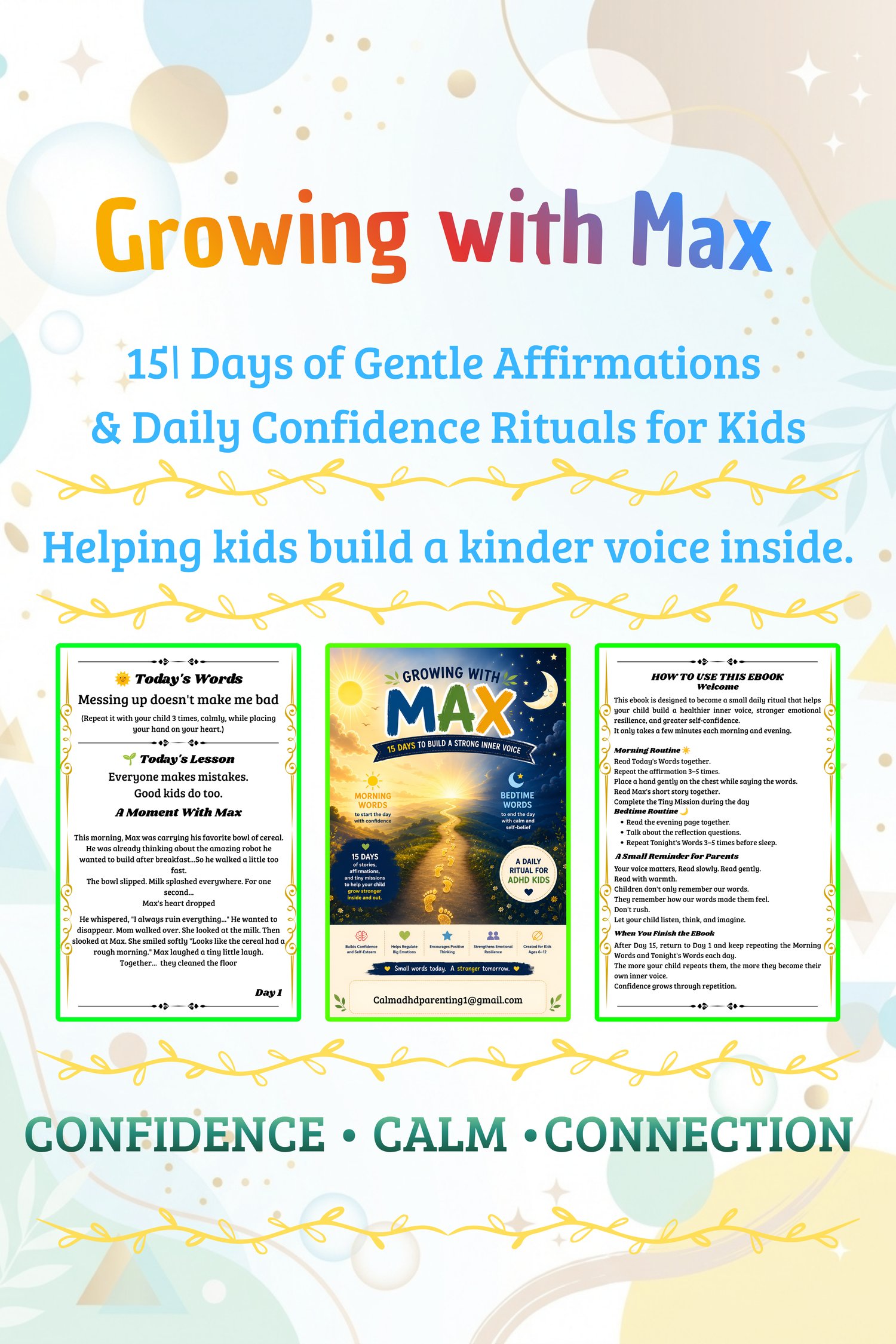
Growing With Max
15-Day ADHD Affirmations & Daily Confidence Ritual for Kids
A simple, gentle daily ritual to help children with ADHD build confidence and develop a kinder inner voice.
Go to purchase pageDigital workbook · Instant download · 30-day money-back guarantee
Comments
Post a Comment